
Low carbon glazing from Pilkington has been specified in the Glass Futures Centre of Excellence.
Glass Futures is a not-for-profit working to revolutionise the glass manufacturing industry and to drive sustainable innovation in the sector. The Global Centre of Excellence in St Helens, Merseyside will be Glass Futures’ new base, as well as a glassmaking testbed.
The £54m facility opened last year its experimental furnace for researching the sustainable glass innovations of the future, due to be installed ahead of its first firing in 2024.
A total of 71m2 of low carbon glass manufactured by Pilkington has been used to fit-out the building’s offices.
Pilkington Optiphon acoustic glass will provide noise reduction between the office spaces. The glass used was produced during Pilkington UK’s world-first biofuel trial last year, in which it became the world’s first flat glass manufacturer to fire its furnace on 100% biofuel, resulting in the creation of 165,000m2 of low carbon glass. This means the building has a lower embodied carbon – the CO2 emitted through its construction, including in the production of the building materials.
The glass produced in the trial and used in the Centre formed a key part of the development process for Pilkington Mirai. The recently launched product has 52% less embodied carbon than standard float glass, making it the lowest carbon product of its kind currently available, according to Pilkington.
It will enable low carbon glass to be specified more widely beyond its initial trial in the Glass Futures building.
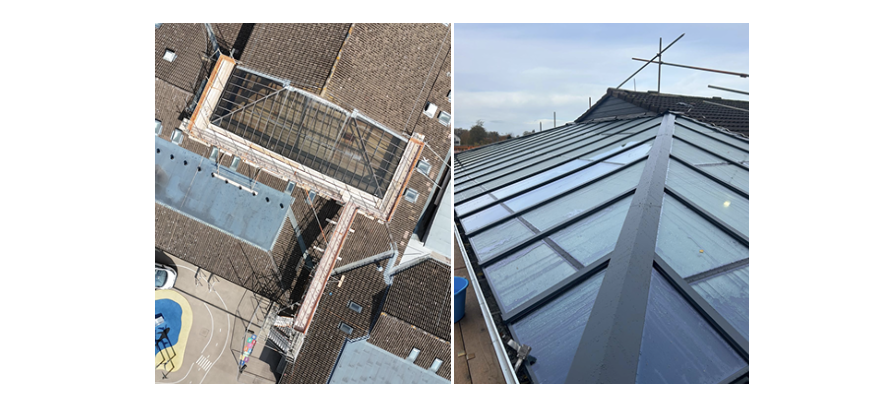
The Centre’s exterior will also utilise Pilkington’s advanced glazing solutions. The 465m2 Glass Futures building has been covered in double glazed units with an outer pane of 8.8mm Pilkington Suncool Optilam 60/31.
The specialist glazing, supplied by Yorkshire-based processor Dualseal, creates a comfortable environment year-round, reducing the need for carbon intensive heating and cooling systems to help improve the building’s environmental performance.
Richard Katz, chief executive and founding director of Glass Futures, said: “It’s exciting to see our base in St Helens nearing completion. It’s the product of hard work and collaboration between so many across the industry and supply chains, to ensure the building champions the sustainable future that we’re aiming to deliver.
“The innovative low carbon glass from Pilkington UK that divides the workspaces in our building is an invisible billboard to the industrial excellence and innovation we hope to inspire within our walls in coming years. I hope the building will act as inspiration for what can be achieved when the industry works together to build a better future.”
Jason Eggerton, national business development manager at Pilkington UK, said: “Glass Futures’ Centre of Excellence has taken a holistic approach to sustainability, considering both its operational and embodied carbon when selecting its building materials. The care and consideration taken showcases Glass Futures’ commitment to a low carbon future for the glass industry, as well as the potential for all in the sector to work together to make change.
“As an organisation that will be integral to realising more sustainable ways of manufacturing glass, it’s fitting that Glass Futures’ will be an early adopter of low carbon glass produced with alternative fuels to natural gas. Glass Futures will provide a testbed for us to advance the work we’re already doing in decarbonising our operations and we are excited to work with them on the journey to net zero.”
Anthony Pollock, managing director for Dualseal, said: “The Glass Futures building stands as an example of excellence and innovation within our industry, which we are proud to have helped supported.
“The installation of Pilkington Suncool Optilam at the new Centre of Excellence will compliment Glass Future’s plans for future sustainability innovations on the site.”