
Despite increasing market pressures, investment in aluminium fabrication machinery remains strong. This is the view of Matt Thomas, managing director at Haffner, who is seeing growing demand for aluminium cutting and machining centres as fabricators focus on improving efficiency, consistency and long-term production capacity.
While the market continues to face economic pressures, fabricators are still investing where they see genuine long-term value. Across aluminium fabrication, we are seeing a clear increase in demand for higher levels of automation.
Automation is no longer simply about increasing output. It is about improving consistency, reducing labour dependency, minimising waste and creating a more efficient manufacturing environment overall.
As the strategic UK partner for FOM Industrie, we supply a wide range of aluminium machinery backed by comprehensive technical support from our team of multiple FOM-trained engineers. One machine seeing particularly strong interest is the FOM LMT 65 machine & cutting line.
What makes the LMT 65 stand out is its ability to combine multiple stages of fabrication into one fully automated process. By integrating machining and cutting operations within a single line, fabricators can streamline production while maintaining exceptionally high levels of precision.
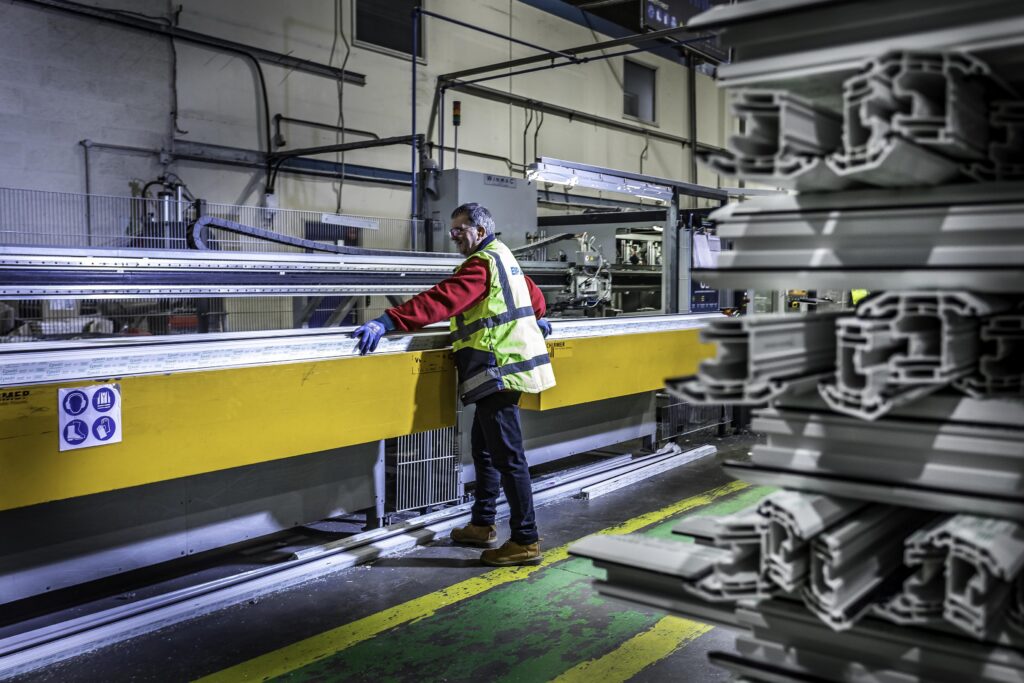
The machine incorporates a loading magazine, automated profile feed and pick-up system, multi-spindle machining unit, cutting unit and unloading magazine, all working together within one continuous process.
Fabricators are under constant pressure to improve productivity while maintaining quality standards. At the same time, skilled labour remains difficult to recruit and rising operational costs continue to impact margins. Automation helps address many of those challenges directly.
Thanks to its high number of controlled axes, the LMT 65 offers flexibility across a wide range of aluminium applications while producing accurately machined and cut-to-size profiles with minimal operator intervention.
In any fabrication environment, repeatability is critical. Manual handling and multiple processing stages can introduce inconsistencies over time. By automating key stages of production, fabricators can achieve far greater accuracy and consistency across every cycle.
That consistency is becoming increasingly important as aluminium systems continue to evolve, particularly with growing demand for larger and more complex window and door products.
Another major advantage is the impact automation can have on overall factory efficiency.
By consolidating multiple operations into a single automated line, fabricators can reduce handling time and improve workflow throughout the factory. The result is faster throughput, improved production planning and greater operational control.
For many fabricators, investment in automation is also about future-proofing capacity. Even against a backdrop of uncertainty, fabricators understand the importance of preparing for long-term growth. Businesses investing now are often looking beyond immediate market conditions and focusing on how they position themselves for the future.
This is one of the reasons interest in aluminium cutting and machining centres continues to accelerate. At Haffner, we are increasingly seeing fabricators looking for complete automated solutions capable of transforming manufacturing efficiency across the business.
The flexibility of the FOM LMT 65 is another key benefit. With 20 different variants available, the system can be configured to suit different production requirements, including left or right feed direction. That flexibility allows fabricators to invest in a machine solution designed specifically to their environment and future growth plans.
Automation within aluminium fabrication will continue to evolve rapidly, but what is already clear is that advanced machinery is increasingly being viewed as a strategic long-term investment rather than a short-term cost. In today’s market, efficiency, consistency and manufacturing control are becoming just as important as output itself.