
Aluplast’s director of sales and marketing, Ian Cocken, says suppliers should be investing for tomorrow’s demands, not today’s.
If the pandemic revealed one thing, it was that a good relationship between supplier and customer relied on keeping your promises, an up-to-date product range, and the willingness to invest.
And no-where have I seen this more apparent than with our new flush door, launched last year.
This has been an interesting development for us, because the flush door isn’t typically a product that homeowners buy on its own. But we know from speaking to our fabricator customers that window orders will often include an outward opening French door because homeowners are increasingly planning whole-house refurbishments.
And suited products are preferred. Why spend more on flush casement windows, only to have them installed alongside a storm casement French door?
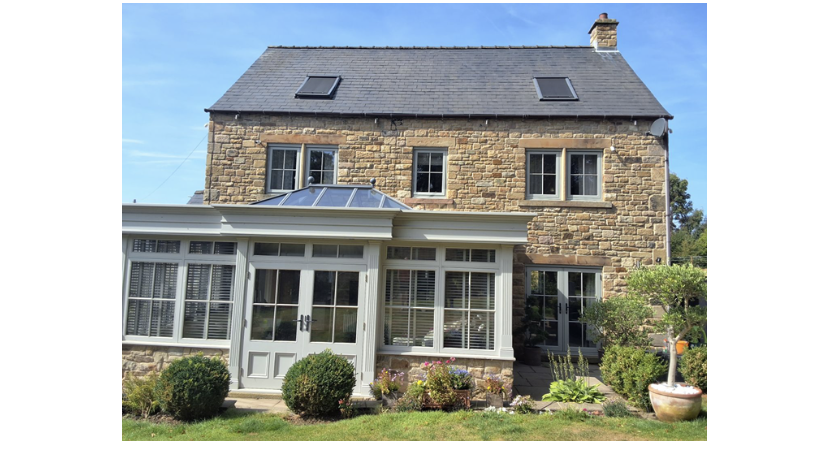
So, the flush element has been a big hit, but so have the other attributes. Again, when homeowners are buying a house full of windows and doors, they aren’t differentiating between the different products. If they have heritage windows, they’ll be combining both the flush sash casement window and the flush door with our Ideal 70 system.
And, like the flush casement window, the flush door is fully secure and weather-tight, having successfully passed the rigorous PAS24:2016 and BS6375-2:2009 testing procedures.
It also comfortably meets the new Part L requirements for newbuild and refurbishment projects because its five-chamber design can achieve U-values as low as 1.2W/m2K. And, like the flush casement window, the flush door is manufactured using Ecotech, which uses recycled content in a profile’s design, enhancing performance.
We could see the way the market was moving, which is why we invested in the flush door, so we are not surprised by just how popular it has been.
What has surprised us is how other systems companies are restricting their flush products to a small section of their fabricator base. We can only assume that they haven’t got the capacity to meet the current demand.
Thanks to our new £26 million extrusion facility on a 15-hectare site in Poland, we are building in capacity to develop new products that create new opportunities for our customers.
Don’t forget that today we are talking about flush windows and doors, but tomorrow we will be talking about Passivhaus standards of thermal efficiency as we meet the requirements of the Future Homes Standard in 2025. And that requires an agile supplier willing to invest in the opportunities of the future.
This kind of headline investment also allows us to be genuinely responsive to the needs of our customers.
For example, coloured profile is driving purchasing decisions for many customers. As a result, fabricators need two requirements from their suppliers: the infrastructure to supply a wide range of coloured profile; and the flexibility to deliver on time.
We have a range of 40 different finishes, including the next generation woodec and aludec foils, which we can deliver in quantities and in time slots that suit our customers. We understand that while keeping a healthy stock of product is important to manage the peaks and troughs of demand, each colour order takes up valuable space in your warehouse.
Not only does this tie up your cash in stock sitting on shelves, but it also takes up space that could be used for other purposes, like a new production line.
Crucially, though, we don’t charge extra for special requests. If you want a heritage green on the outside, and grey on the inside, we won’t charge our customers extra for that. We know that this is the way the industry is moving, and we have invested in high-end, high-tech CNC machines that allow us to do short runs of foiled profile very easily. It is in our interest to meet your requirements rather than erect barriers to sales.
Flush and colour are driving sales at the moment, but we expect to see new drivers further down the line, and we are investing now to meet those demands.