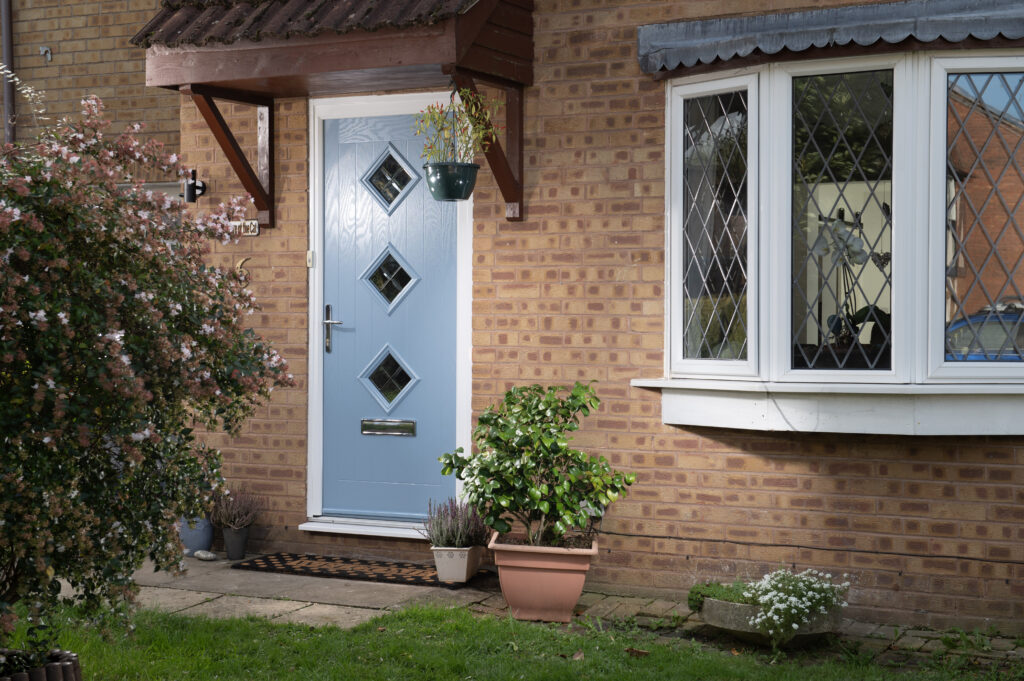

Spitfire Doors says it is ‘uncompromising’ when it comes to thermal performance.
The company adds that doors across all ranges are engineered to achieve exceptional U-values below 0.9 W/m²K, giving homeowners confidence that their entrance door will exceed Building Regulations for years to come.
Many models even meet the demanding Passive House standard of 0.8 W/m²K, combining high-performance materials with long-term reliability and durability.
The best-selling Spitfire S-200 aluminium Series has recently been upgraded and is now available flush inside and out, designed to complement modern flush aluminium and PVC-U window systems.
In response to partner demand, the S-200 now also features colour-matched hinges – an important detail that Spitfire says consumers expect on a premium product. With over 60 door designs, hundreds of RAL finishes and a new slam-shut lock, the S-200 is said to be suitable for all markets.
The S-200 can also be specified with biometric access control. The tried and tested Navkom system, launched 18 years ago, has proven to be reliable, simple to install and highly secure, according to Spitfire.
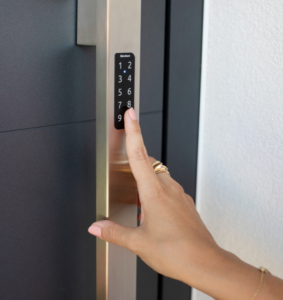
Designed around safety, simplicity and convenience, the fingerprint reader uses certified technology that is reported to be ‘virtually impossible’ to fool. Users can unlock the door with a touch or code, while the intuitive mobile app allows access management, additional user setup and entry tracking.
Spitfire claims that many homeowners opt for biometric entry to avoid the frustration of lost keys and the late-night wake-up calls to let someone back in. The company adds that once homeowners experience keyless entry, few choose to go back – no member of staff at Spitfire reportedly uses a key to access the Macclesfield showroom.
To further future-proof its doors, Spitfire recommends textured or structured paint finishes. Independent European testing confirms they offer greater weather resistance and durability than standard matt or gloss, while being more forgiving when the door is subjected to light impacts, for example from bicycles, young children or dogs.