
By Mike Butterick, marketing director, Saint-Gobain Glass.
For decades, the approach to safety and security glazing has been relatively straightforward: if you need greater protection, you add more material. But as the demands placed on homes and other buildings become increasingly complex, the industry needs to think differently about how that performance is delivered.
Today’s glazing has to do far more than provide a barrier. It needs to contribute to energy efficiency, acoustic comfort, security, sustainability and occupant wellbeing, while remaining practical to manufacture, transport and install. At the same time, the growing use of triple glazing is putting a renewed focus on weight, making lighter glazing solutions increasingly important across the supply chain.
This is where thinner glazing can offer more.
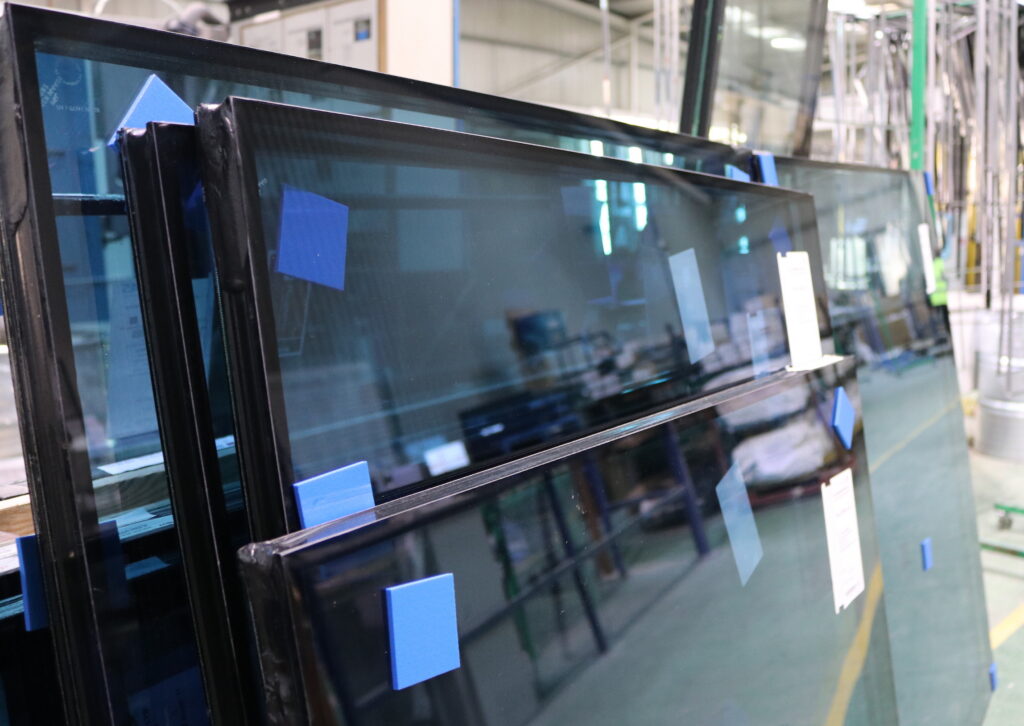
Saint-Gobain Glass has expanded its Stadip laminated glass range with the launch of 4.8mm Stadip Plus, an innovative thinner laminated glass designed to deliver P2A safety and security performance while significantly reducing weight compared with thicker laminated alternatives.
That weight saving is relevant to both double and triple-glazed units. For glass processors, lighter glass is easier to handle through the manufacturing process and reduces weight during transportation. For fabricators and installers, lighter insulated glass units (IGUs) are easier and safer to handle on site, bringing potential health and safety benefits.
There are benefits for the finished window, too. Reducing the weight of an IGU places less load on window frames, hinges and friction hinges, which can support reliability and potentially reduce service and warranty issues over the lifetime of the window.
The key achievement is maintaining recognised P2A safety and security performance to EN356 in a laminate just 4.8mm thick. That reduction in thickness may sound relatively modest, but it can have significant consequences for how double and triple insulated glass units are designed and manufactured.
Making space for better performance
One of the biggest opportunities created by a thinner laminate is the additional space available within a standard insulated glass unit.
For example, in a 24mm double-glazed unit incorporating Planitherm Neo, replacing a 6.8mm Stadip laminate with 4.8mm Stadip Plus allows the cavity to increase from 14mm to 16mm. With 90% argon, this can improve the centre-pane U-value from 1.1 to 1.0 W/m²K.
The same principle is particularly valuable as triple glazing becomes more widely specified. In a suitable triple-glazed configuration, 4.8mm Stadip Plus can achieve a centre-pane U-value of 0.5 W/m²K, compared with 0.6 W/m²K for an equivalent thicker laminate configuration.
Importantly, 4.8mm Stadip Plus is not only about making room for a larger cavity. It can also replace 4mm monolithic glass while maintaining the overall IGU configuration, bringing improved security and acoustic performance without increasing the overall unit width.
A typical 4/16/4.8 Stadip Plus insulated glass unit can achieve an Rw value of 34dB, compared with 31dB for a comparable monolithic glazing unit. Selected configurations can also deliver high levels of daylight transmission, demonstrating that security, acoustic performance and occupant comfort do not have to come at the expense of a practical glazing specification.
Sustainability must be built into innovation
4.8mm Stadip Plus is manufactured in the UK using lower-carbon Planiclear glass as standard. Its independently verified Environmental Product Declaration for 4mm Planiclear records a Global Warming Potential of 7.22kg CO₂e/m² for modules A1-A3, representing a reduction of more than 34% compared with the previous Planiclear EPD.
For house builders and social housing providers, this creates a particularly straightforward opportunity. With embodied carbon becoming an increasingly important consideration when selecting products and supply chain partners, switching to a thinner laminated solution provides a simple, measurable way to reduce the carbon impact of glazing across large volumes of homes.
For a volume house builder or social housing provider, even a relatively small saving per window can become a significant number when multiplied across an annual programme, with no compromise on the required product performance.
This sits alongside Saint-Gobain Glass’ wider investment in circular manufacturing. Through its Glass Forever programme, every tonne of recycled cullet used in float glass manufacture avoids approximately 1.2 tonnes of virgin raw material extraction and around 700kg of CO₂ emissions across Scopes 1, 2 and 3.
Innovation that works across the supply chain
Perhaps the most significant shift is the move away from thinking about glazing products in isolation.
For residential new build and replacement, 4.8mm Stadip Plus demonstrates how one relatively simple change can deliver benefits throughout the glazing lifecycle: lighter units for processors, easier handling for fabricators and installers, reduced loads on frames and hardware, easier transportation and lower embodied carbon for the finished building.
And because it delivers the same required safety performance as the thicker laminate, the question is increasingly: why carry the additional weight when a thinner solution can do the job?
By combining recognised security performance with reduced weight, improved thermal efficiency, acoustic capability, daylight transmission and lower embodied carbon, thinner laminated glass demonstrates that sometimes the smartest route to better building performance is to use less, but engineer it better.