
By Dave Thom, senior sales rep, Smart Glazier Software, a Cyncly company.
UK glass processors have made ordering remarkably easy for their customers. An installer can send an email, attach a spreadsheet or sketch, and leave the processor to work through anything that is missing.
The process feels straightforward at the point of order. Behind the scenes, the processor is working from incomplete information, making judgement calls the customer doesn’t know they’ve delegated.
Someone must interpret the drawing, check the specification, identify missing details and enter the information into another system. The processor has to either make assumptions about what the customer intended or delay the order while seeking confirmation.
In practice, much of the responsibility sits with the processor. If the finished glass is disputed, the processor may still be expected to resolve the problem or absorb the cost, even when the original information was incomplete.
Processors understand that more structured digital ordering could reduce this risk. The difficulty is that some installers may resist a process that makes them more responsible for confirming the dimensions, specifications and choices they submit.
That is the real challenge for online ordering in the UK: creating greater certainty for the processor without making the customer feel like they are taking on additional work or responsibility.
The customer experience comes first
Many UK processors know that online ordering technology works. The question is whether customers will see it as easier than the methods they already use.
That depends on how the experience is designed.
Installers should not need to understand every production rule or become CAD users to order glass. The process should guide them through the information needed for that particular order, whether they are entering a simple rectangular panel or a more detailed shaped or configured product.
The objective is to collect the right information at the right time without overwhelming the person placing the order.
Done well, the same process can also help installers sell more effectively. Instant pricing from their processor can shorten the time it takes to prepare a quote, while professional 3D designs can help customers understand what is being proposed.
A structured system also allows more people within the installer’s business to quote accurately and confidently, rather than relying on a small number of experienced employees to understand every product and calculation.
That gives processors a stronger reason for customers to adopt online ordering. The same approach that asks installers to take greater responsibility for their orders also gives them a tool that can help them quote faster, improve their presentations and win more work.
Adoption does not have to happen all at once
The UK glass market is unlikely to move from emails and sketches to fully digital ordering in a single step.
It does not need to.
Processors can begin with regular customers, straightforward products or a particular product range.
Internal sales and order-entry teams can also use the same platform for orders that still arrive by telephone or email, creating a more consistent process before customer adoption becomes widespread.
Starting gradually gives the processor time to refine the experience, simplify common ordering journeys and add guidance where customers need support.
It also allows the processor to demonstrate the benefit before asking every customer to change. Once installers see that digital orders can provide quicker pricing, reduce follow-up calls and help more of their team quote accurately, the process has clear value for them too.
Connecting the customer order to production
The value of online ordering increases when the information captured from the customer continues into the processor’s wider workflow.
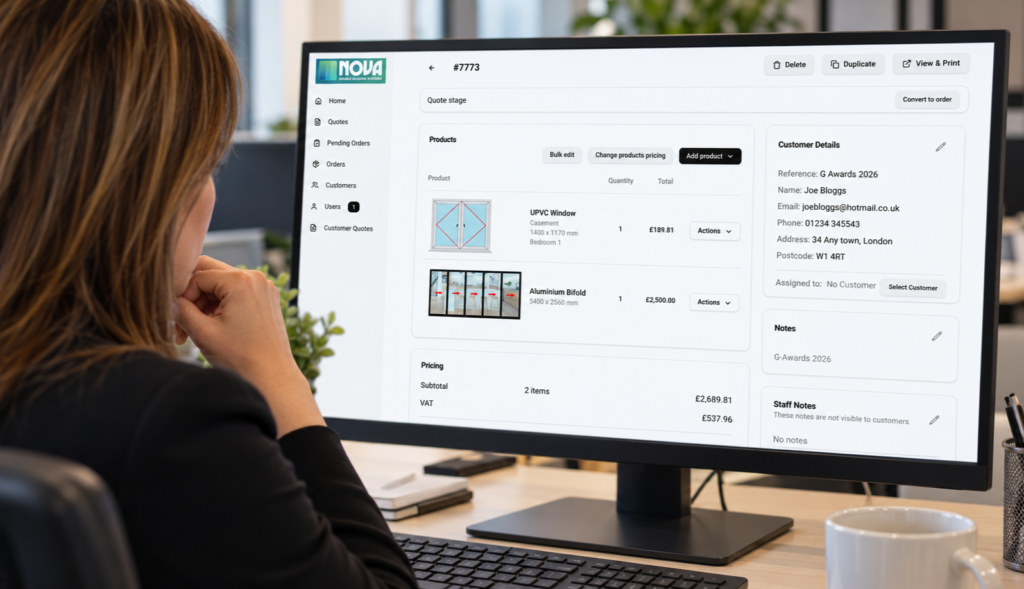
We built Smart Glazier Connect because we know the failure point isn’t usually the technology, but rather whether the customer will actually use it. Smart Glazier Connect is an online ordering platform for glass processors that gives processors a customer-facing system under their own brand, allowing customers or internal teams to configure, price and submit orders through a guided digital process. Processors can decide which products, options and ordering journeys they make available, from straightforward glass orders to more detailed project designs.
The platform draws on Smart Glazier Software’s experience developing specialist software for glass installers. This means the customer-facing workflow is not designed only around what the processor needs to manufacture the glass. It also considers how installers design, price, quote and present their work.
The aim is to capture clearer information at the source, while making the process simple enough for customers to use.
National Glass provides a practical example. The company reported that its customers found Smart Glazier Connect easy to use. Its order-entry team could then check the information customers had submitted instead of entering each order from scratch, helping to improve lead times and order accuracy.
Precision Glass Industries has seen the effect at greater scale: “Smart Glazier Connect has helped us grow tremendously as a company… it has allowed us to do so much more with the same number of personnel that we had.
We are pushing almost 450 orders a day with the same number of people that we were pushing 100–200 orders.”
Precision Glass Industries has also described customer-submitted orders as its preferred way to accept work because they save production time and eliminate errors caused by re-entering customer information.
The operational benefit is clear. Better information enters the business once and can continue through the workflow with less interpretation, duplication and manual handling.
This supports Cyncly’s wider vision for a connected “field-to-factory-and-back” digital thread, linking the people measuring and specifying glass with the systems used to process and manufacture it.
The integration between Smart Glazier Connect and FeneVision brings that vision into a practical workflow. FeneVision Core is Cyncly’s management and production platform for glass processors.
Through FeneVision Core Connect, its integration framework, fully designed shower orders can move securely from Smart Glazier Connect into FeneVision Core as manufacturing-ready line items.
Complex CAD and DXF geometry, including edges, notches and cut-outs, can be transferred directly into FeneVision Core’s pricing, scheduling, CNC and labelling workflows. This reduces the need to redraw designs, share files manually or re-enter information before production begins.
For UK processors considering FeneVision, the integration shows how customer-facing online ordering can become part of a broader connected production workflow, rather than remaining a separate website tool.
Smart Glazier Connect can also support hardware suppliers, particularly where orders involve product configuration or compatible component selection. For UK processors, however, the immediate opportunity remains the glass order itself: receiving clearer information and moving it towards production with less manual handling.
The direction is clear
Online glass ordering in the UK will not be driven by technology alone. It will depend on whether processors can create an experience that customers see as useful, while reducing the hidden cost and risk of incomplete orders.
The most successful portals will be the ones that make routine orders simple, provide guidance when complexity increases and create a clear, agreed specification before production begins.
The move towards online ordering may be gradual. It may begin with one product range, one customer group or the processor’s own internal team.
But processors do not need to wait for the whole market to change. They can start by removing complexity from the next order. Once information begins moving cleanly from order to production, becomes difficult to remember why you ever worked any other way.