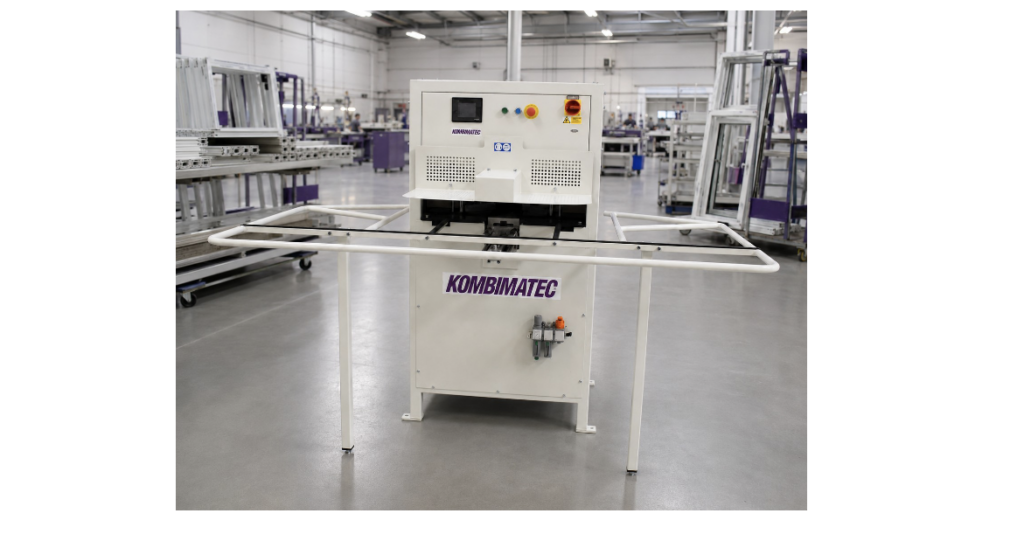

Jade Engineering’s JBC2 reverse butt weld cleaner eliminates the requirement to use outdated weld cleaning techniques, enhancing health and safety and introducing greater efficiency on the factory floor.
Modern window and door manufacturing factories are a stark contrast to the facilities that were powering the ‘white gold’ boom of the 1980s and – such is the pace of progress – even factories that would have been regarded as ‘state of the art’ 20 years ago, would now be deemed old fashioned and inefficient.
Much of that is due to the evolution of machinery, which has introduced levels of automation that would have been regarded as science fiction when the first double glazed PVC products were being produced, but it also owes just as much to the change in approach to health and safety.
When the Health and Safety at Work Act become law in 1974, it established a framework that fundamentally changed the responsibilities of employers towards the people working for them.
For today’s manufacturers, protecting the physical wellbeing of the workforce is an ongoing responsibility, particularly when people remain the most important asset for businesses.
And while more rigorous H&S protocols have helped to raise standards and reduce accidents over the years, technology has also become an important part of the health and safety equation.
Sophisticated guard rail systems for example, that help prevent access to potentially dangerous machinery are now commonplace, while other industries are starting to adopt autonomous or collaborative robots that are designed to enhance both efficiency and safety at work.
If the notion of humanoid robots in window and door factories seems a little far-fetched (for now…), then the idea of introducing machinery to replace a process that would otherwise require repetitive, inefficient and potentially harmful manual manufacturing techniques is probably more palatable.
This is where Jade Engineering’s JBC2 reverse butt weld cleaner presents an interesting proposition, as it has been designed specifically to automate a manual technique that has traditionally been carried out with a moon knife – the distinct, crescent shaped implement that is also known as a ‘Don Carlos’ knife thanks to its association with the German blade making brand.
“Cleaning reverse butt welds has always been one of those tasks that’s traditionally done by hand, but in a modern factory, where safety and efficiency are the number one priority, we believe it’s a pinch point that could be far better resolved with an automated process,” explains Jade’s Sean Mackey.
“After talking to customers, it’s something that we decided to resolve through Jade Consult, which is a resource that we introduced to help fabricators improve production flow and enhance product quality but also look at ways to optimise health and safety.
“And when you consider the level of automation on most factory floors these days, the quality of engineering and the introduction of sophisticated software and even AI, then the idea of an operative – no matter how skilled – using an old-fashioned knife to clean frames seems completely outdated.”
Available at an unbelievably reasonable cost, the Jade JBC2 reverse butt weld cleaner not only delivers a much safer, more modern solution, it also helps to de-skill a time consuming and potentially hazardous process, freeing up resources that can be deployed elsewhere on the factory floor.
In addition to the obvious improvement in health and safety standards, the Jade JBC2 also significantly improves speed, efficiency and consistent product quality.
“When we talk about improvements on the factory floor, the default reaction from many fabricators is that it’s going to cost a huge amount of money,” says Sean. “That is often true if you’re overhauling an entire production line, but in our experience, we can also find solutions that are designed to make a big impact, without having to invest tens or hundreds of thousands of pounds.
“The JBC2 is a perfect example of that,” he continues. “It’s a very modest outlay in machinery terms, but because it’s also compact in size, it can be inserted into most production lines with very little disruption.
“That brings a host of tangible advantages at a time when budgets are tight, but perhaps most importantly, it means fabricators can take a meaningful step forward on health and safety by overhauling a manual process that really should be consigned to the history books.”