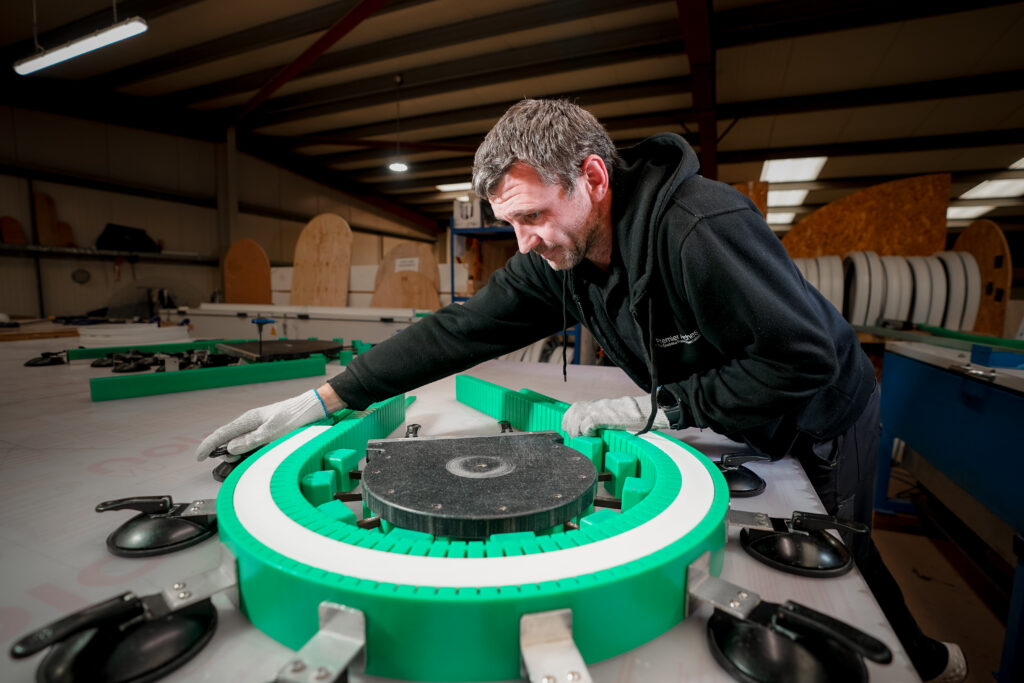

By Danny Williams, managing director of Pioneer Trading.
In any industry, there are usually a few large manufacturers that dominate the market, and the IGU sector is no exception.
These larger manufacturers are the market ‘makers’, as they have the power and influence to set prices and influence the behaviour of everyone else in the market.
But with that power and influence, why are they so determined to undermine it by selling product at unrealistically low margins and thus drive what can only be a race to the bottom? A race that threatens the structure, if not the very existence of a viable and competitive IGU industry.
Buyers of IGUs at this point may be thinking, ‘here we go again, another doom-monger threatening the end of the world just to drive up prices and make more money’.
But the reality is that after the failures amongst IGU makers in recent years, if the IGU sector reduces any further then there is a very real risk that prices will not just rise, but will do so without control. But currently, the industry is selling at prices lower than they need to be that are unhealthy for end users, let alone us IGU makers.
The biggest producers in the industry, with group turnovers in excess of £100 million, make very scant profits and with every negative turn in national and global politics and economics, sail even closer to the edge when they show such reluctance to raise their prices, even to simply cover the increases that they face.
One or two percent lower profits will plunge many into loss. But whilst they may have greater pricing power than smaller manufacturers, they still face the same economic realities that impact the entire industry. As the cost of doing business and competition increases, we all need to be adaptable to remain viable.
However, the IGU market-makers are even more exposed to economic realities than us smaller operators and face greater pressure from market changes. But when demand for their products decreases, then even despite the expertise that they can all afford to utilise, they immediately panic and slash prices to retain market share.
Market share…always the driving factor…not profit…market share; and the two seldom go hand in hand.
Apart from the financial implications created by the knee jerk reaction of slashing prices, experience and history dictate that once prices are reduced, it is very difficult to reinstate them; the culture within the company becomes ‘price conditioned’ and fearful of implementing increases, even when smart business warns against such practices.
I am as competitive as it is possible to be manufacturing and selling IGUs in a market that is created by the market-makers. In fact, not only have I survived but my IGU business, if not thriving, continues to be a worthwhile and dependable source of IGUs for my trade customers and also my own commercial installation business.
We are not always the cheapest but crucially, our customers know that we are dependable; that when the brown stuff is hitting the fan, we will help them out and get them out of trouble, usually within hours.
But the market-makers continually selling their products so close to cost, undermines our ability to provide that service and indeed, the structure and function of the whole industry. Selling at unrealistically low prices reduces investment across the whole industry, which means that ultimately, corners have to be cut in terms of product quality and service. And I would maintain that is more likely to happen amongst the larger producers.
Some of the major firms are funded by private equity that demands short-term returns and loaded accounts whilst others are benefitting from cheap float imports, the result of market pressures elsewhere in the world and lower shipping costs.
But even with these factors in mind, IGU prices are too low to be sustainable. Unsustainable for the producers of course, but ultimately, for the end users, who will see further supplier bankruptcies resulting in less choice, as well as more product failures, set against a backdrop of significantly poorer service.
Do I believe that the bigger IGU makers will take any notice of my rant? I would be very surprised. In which case you, Mr Installer, should not be surprised in due course that when the broken IGU that turned up on your latest consignment, takes a fortnight to replace, instead of 24 hours.