

Smart access technology is not new. We unlock cars without keys, approve payments with facial recognition and use smartphones to manage almost every part of daily life. Yet in the UK door market, smart locking is still too often treated as a niche option for high-end projects.
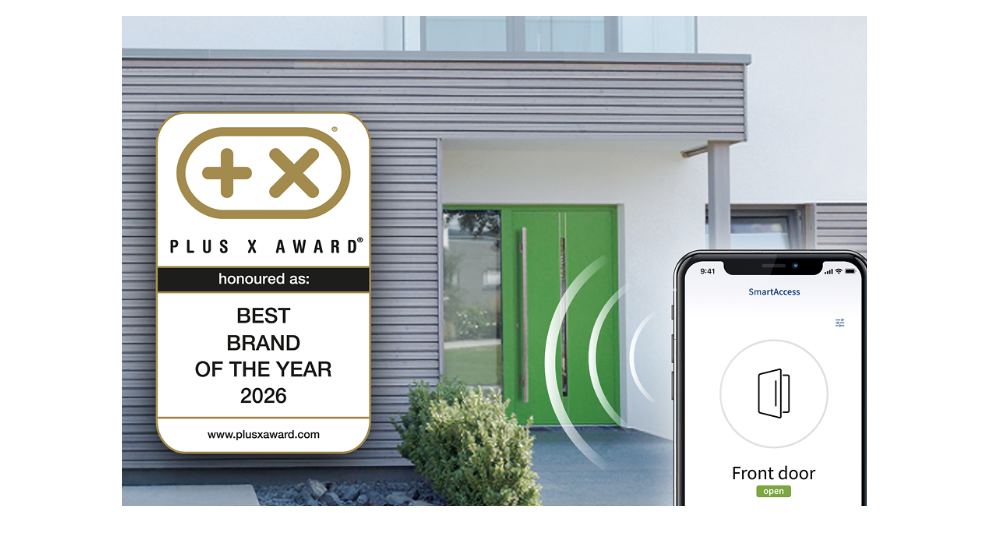
Products such as Fuhr’s SmartAccess multiscan, SmartAccess Module (SAM) and SmartTouch solutions show how easily access control can now be built into modern entrance doors. The challenge is whether homeowners are being shown what is possible.
“We often hear that people are not asking for smart locking,” says Paul Balfe, business development manager at Fuhr UK. “But homeowners did not ask for keyless car entry until manufacturers made it available and explained the benefit. Once people understand the convenience, security and usability, the conversation changes very quickly.”
Fuhr’s SmartAccess multiscan is a compact biometric fingerprint scanner designed to unlock Fuhr motorised multipoint locking systems. It can be surface-mounted or flush-mounted into the door leaf, or integrated into a bar handle, offering design flexibility for aluminium, timber and PVC-U doors.
Security is central to the system. SmartAccess multiscan works with Fuhr’s SmartAccess Module SAM, fitted inside the door, and communicates via Bluetooth 5. There is no need for Wi-Fi, internet connection, mobile data or cloud storage. Biometric data remains encrypted and stored locally within the door, with no external access, not even by the manufacturer.
The system also includes liveness detection, fixed pairing between the scanner and SAM module, and a false acceptance rate of 1 in 10,000,000. In practical terms, unauthorised access is about as unlikely as winning the lottery jackpot.
“Security concerns are understandable, but modern biometric access control systems are extremely advanced,” says Paul. “The important point with SmartAccess multiscan is that the data stays within the door. It is not sitting in the cloud or linked to personal accounts, which gives specifiers, installers and end users a clear security message.”
SmartTouch adds another option without the need to use a key, keypad or separate reader. Once a user with an authorised smart phone in their pocket touches the handle or integrated sensor, SmartTouch sends the opening signal to the Fuhr motorised multipoint lock, allowing the door to unlock automatically.
Depending on the design requirement, the whole handle can act as the sensor, or the sensor can be incorporated discreetly into the bar handle. Options include square or round profiles, straight or angled supports, stainless steel or matt black finishes and different lengths.
This is not only about convenience. For homeowners who struggle to operate a standard handle, touch-based or automatic unlocking can make everyday access easier and more comfortable. In care environments, multi-generational homes or accessible housing, that usability becomes more than a premium feature.
For installers and fabricators, offering smart access options moves the sales conversation away from direct product comparison and towards how the entrance will work day to day.
It also supports a wider repositioning of the door and fenestration industry. For years, the sector has worked hard to move away from the old “BOGOF” perception of replacement windows and doors, and towards a more professional conversation around design, performance, security and long-term value.
“Not every customer will choose smart access,” says Paul. “But if it is not offered, they cannot choose it at all. Adding these technologies to a range gives installers a stronger proposition and helps position them as leaders in their local market.”
Fuhr understands that adoption depends on confidence as much as innovation. Support therefore goes beyond product supply, with technical guidance, documentation and early-stage advice to help customers integrate access control correctly from the outset.
With over 165 years of experience in multipoint locking systems, Fuhr combines manufacturing pedigree with modern access control innovation. The technology is ready; the next step is making sure homeowners know it exists.