
By Joe Trueman, director, Premier Arches.
Shaping PVC-U profiles into arches, angles and bespoke geometries is one of the most specialised processes in the window and door industry.
Unlike straight-frame fabrication, which is optimised for repeatability and high throughput, shaping requires controlled heating, precise forming and a sequence of manual and mechanical operations that must respond to the exact geometry of each order.
Here’s an outline of the practical steps involved, based on the workflow inside our shaping facility.
Preparing the profile: Every job begins with selecting the correct PVC-U profile for the system the installer requires. At Premier Arches, we work across 11 window and door systems, with seven held in stock, which allows us to match the exact profile needed for each shaped frame.
Cutting is completed before any heat is applied, ensuring each length corresponds to the dimensions required for forming. Accuracy at this stage is essential, as it determines how the profile will sit within the forming jigs later in the process.
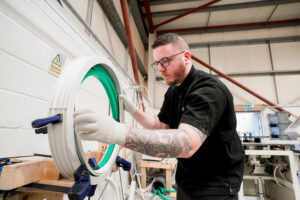
Thermal conditioning: The cut profile then enters controlled heating. PVC-U becomes mouldable within a precise temperature range, and achieving an even, consistent level of flexibility across the full length of the profile is critical.
Uneven heating would create weak points – overheating would affect the finish or structural stability. The aim is to bring the material to a state where it can be guided around a jig without introducing stress marks or distortion.
Operators monitor the condition of the profile closely at this stage. Each system behaves slightly differently when heated due to variations in wall thickness, chamber design and reinforcement, so there is no single set of parameters that suits every profile.
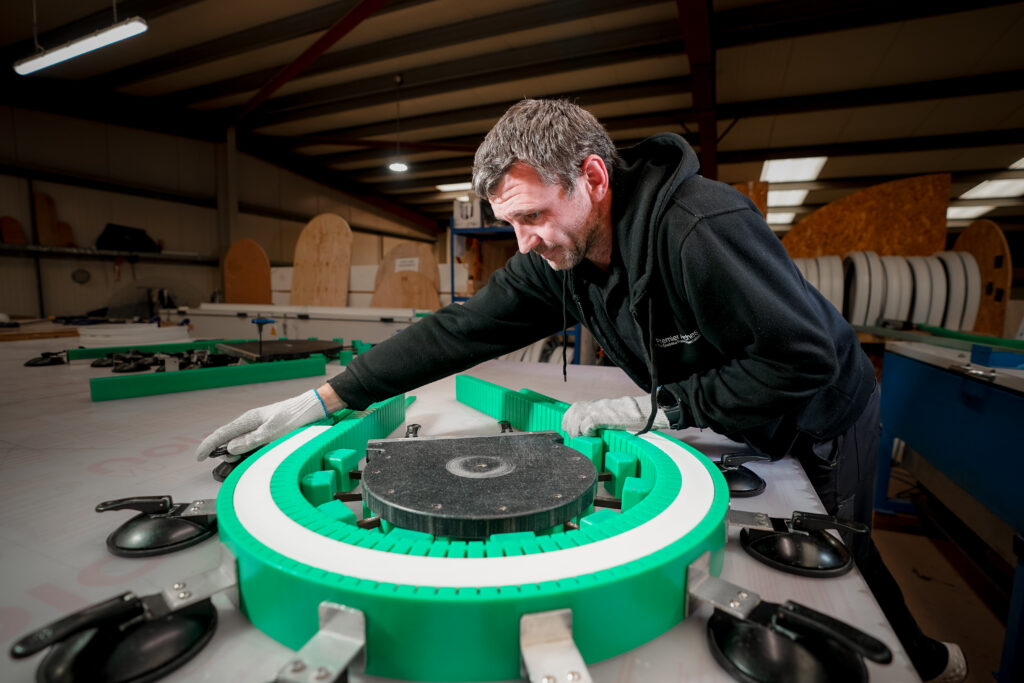
Setting up the forming jigs: While the profile is conditioning, the forming jigs are prepared. These are set precisely to the customer’s required geometry, whether that is a true radius, a segmental arch, a gable angle or a bespoke template. Because shaped frames do not rely on fixed tooling, each jig configuration is unique to the job. The accuracy of this setup is fundamental to achieving the correct final shape.
Forming – controlled bending: Once heated, the profile is transferred to the jig and gradually guided into position. This stage requires controlled force and careful support to ensure the profile follows the intended radius or angle without flattening or twisting.
Operators adjust their forming technique according to the profile system and the complexity of the shape. Understanding how the material behaves at this stage is one of the core skills in shaping PVC-U.
Rapid stabilisation and cooling: After forming, the profile is held in place and allowed to cool. Cooling must happen under full constraint to preserve dimensional accuracy and prevent spring-back. Rapid stabilisation helps lock the curve into position, ensuring that the geometry remains exactly as specified once the profile returns to a rigid state.
Cutting, welding and assembly: Once shaped, the profile enters fabrication. Curved and straight sections are cut to their final mitres and welded together. Because shaped frames do not follow standard 90-degree joints, welding requires additional skill. Operators carry out detailed hand scribing to ensure joints meet cleanly and that tolerances remain tight across curved or angled transitions.
Following welding, the frames move through sanding and polishing. This stage refines weld lines, smooths surfaces, and brings the frame up to its final finish. Much of this work is manual, relying on operator judgement to maintain consistency and quality.
Finishing, assembly and glazing: Once polished, the shaped outer frame can either move directly to dispatch or continue through further stages depending on the order. Sashes may be fabricated and fitted, hardware installed, and the frame beaded. Where required, matching shaped or angled glass units are fitted, producing a fully glazed, ready-to-install assembly.
A precision process
Shaping PVC-U is defined by controlled heating, accurate jigging, careful forming and meticulous finishing. It differs from standard fabrication not in material, but in the degree of precision and manual skill required throughout. Every curve, angle and joint is unique to the job, and the process is built around ensuring the final frame reflects that geometry exactly.