
As Quickslide marks its 20th anniversary, Glass Times editor, Luke Wood, talks to chairman, Adrian Barraclough, about what has made the company such a success and its plans for the future.
Luke Wood (LW): What was the inspiration for launching Quickslide 20 years ago?
Adrian Barraclough (AB): Prior to launching Quickslide, it was noticeable that these gorgeous, elegant heritage style properties that had got traditional sash windows in were either being replaced by standard casement windows – which just didn’t look right – or timber products that were profoundly expensive.
So, we set about making a window that could accurately replicate the traditional aesthetics of those original timber sliding sashes, but with all the advantages of PVC-U in terms of performance and price point.
We started off, 20 years ago, doing just a few every week, and we’ve since grown into a national supplier with a turnover of £35-40 million.
LW: How has the industry changed since 2004?
AB: It’s a huge question. The industry has moved on at a phenomenal rate, I think far more than any other home improvement sector. Going back 20 years, windows were regarded as just a building product. They were traditionally bought by builders and they were just there to fill an opening between the brickwork.
When we entered the market with affordable, high quality PVC sliding sash windows it was initially a hard sell. I was approaching trade clients who said there’s no call for it because the public didn’t really consider sash windows to be available in PVC. It was always considered a timber product.
Today is a wealth of companies offering different styles and designs of windows, that are increasingly better looking, more energy efficient and secure.
Today, we see far more interior designers and homeowners making really powerful decisions on the fenestration of the property because they want to make their home really special. The amount of options is now huge.
LW: What are the primary driver for sales now in the home improvement market compared to 20 years ago?
AB: I think the first thing homeowners consider is the design. When people are looking at fenestration options, not just the windows but the doors, there’s so many different options and colours and I think that’s a result of the industry promoting the message that every white window is a wasted opportunity. Let the street know you’re doing something different.
And we all like the look of timber windows, but we don’t like the performance. So, the industry has gone very much towards flush sash, and the mechanical joint features.
Coupled with that, the increase in energy prices has made windows the most wonderful opportunity to dramatically improve the thermal properties inside a home. Together with the security systems on modern windows, you really get three benefits in one: you get a fantastic new look, you get the energy saving, and you get that added benefit of the security knowing that modern windows today are pretty much impenetrable.
LW: Can you highlight any standout milestones or achievements for Quickslide in the last 20 years?
AB: We’ve won national and regional awards, we’ve hit certain milestones with volumes of productions and turnovers but actually I think things are better achieved when they’re gradual and just progressive.
We’ve always got something in the pipeline, new products or services, and we have a lot of talented people in the business that have really achieved some great things and are continuing to do so.
So, our success and growth are down to a gradual process of just having the business as a working model for our customers to thrive, our staff to thrive, and our suppliers to thrive.
LW: Do you think it would be easier or harder to start a fabrication company from scratch now compared to 20 years ago?
AB: It would be a lot harder now. Back then, it wasn’t difficult to set up a factory making standard white casements, you could probably do it with £15,000 to £20,000 of old machinery and five or six staff.
But the market now wants options. Homeowners want all different styles of windows, and they want them within a couple of weeks.
There’s no way that a smaller, industrial estate fabricator can now cope efficiently with that demand.
We’ve had many clients over the years that have manufactured casement windows in little units. Once we worked the economics and said, just turn that into a showroom, offer lots of different people’s products out to the market and redeploy the fabricators into salespeople – their turnover has gone up three or four-fold.
LW: Quickslide remains a privately owned company and is targeting further growth in 2025 and beyond, but do you see smaller – and even some larger organisations – falling by the wayside in the short to medium term?
AB: I do see further consolidation in the industry. But I think since COVID, since we all had that boom period, there have been examples of outside investors buying into the glazing industry, trying to increase the turnover by 50% and that has fuelled a race to the bottom on price with other fabricators who are chasing the volume sales. So, I think we will see more casualties in the next 12 months.
But eventually we’ll get back on an even keel and those fabricators that will remain will have invested in technology, machinery and software to go to the next level – so we’re going to come out of it in a better place.
LW: Why is it such a challenge for fenestration companies to avoid the race to the bottom on prices?
AB: We you look at the margins in the kitchen or bathroom industry, for example, compared to this industry, we sell ourselves cheap. And I think it’s because we compete against each other. We have a multi-billion-pound industry, but if we stopped fighting amongst ourselves, and worked together collectively, it could be so much bigger.
A national advertising campaign, promoting the benefits of new windows and doors, would be a great initiative for the industry and give us all some much-needed margin.
In the past, the big national retailers would do a good job of this, including with prime-time TV advertising, but that national marketing has since fallen away, along with an older generation of traditional salespeople, the door knockers, the people that were canvassing.
At Quickslide, we help our trade partners as much as we can with lead generation and marketing tools, in order for them to become better retailers.
We’ve got a large, in-house dedicated marketing team – and we’ve invested heavily in digital technology – that’s all designed to support our clients improve their own marketing and grow their businesses.
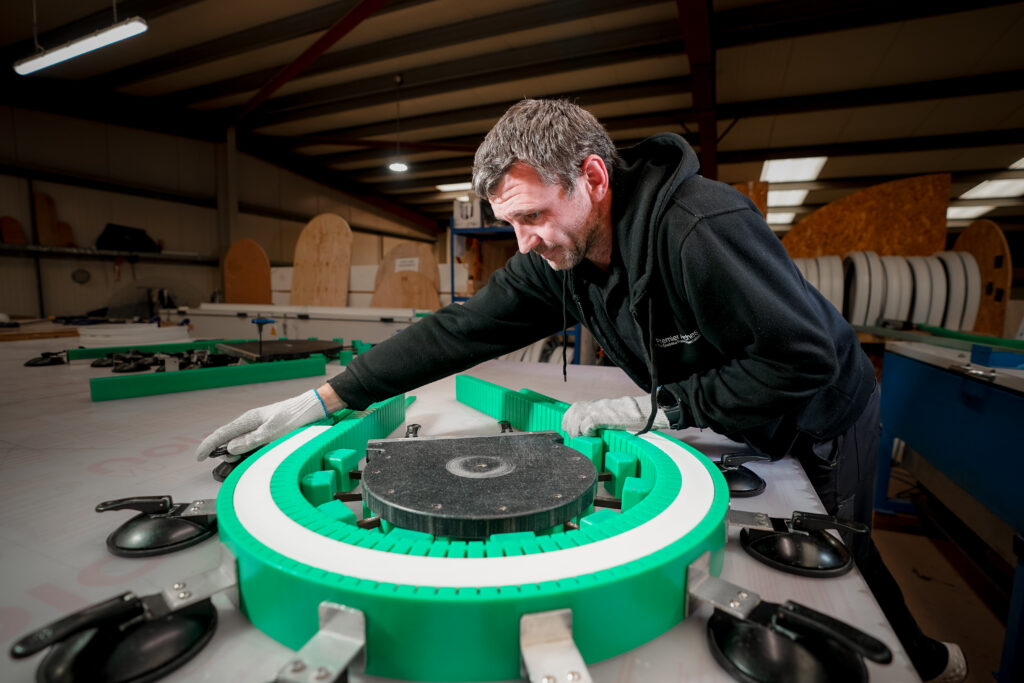
LW: Quickslide has invested considerably in machinery, and now has one of the most sophisticated factory floors in the UK. Do you have plans for further investment in machinery in 2025 and beyond?
AB: Absolutely, we’ve got another machine coming in the next two months that represents an investment of well over a million pounds and we’re really excited about this as it’s going to further enhance the quality of our product and level of service to our trade partners.
The new machinery is a highly visible example of how we’re investing in the future of Quickslide, but what people may be less aware of is the team of people we have here that are forever improving the software and technology in order to upgrade our processes.
A good example of that is the work that’s been done to improve our deliveries, so that our customers know exactly when their products will arrive, and the fact that everything has to be scanned off the truck – and the complete order is given a green light – before the driver heads off to the next job. Deliveries are quicker, more efficient, there’s much less chance of forgetting or losing a cill pack or handles – it’s a far improved experience all round.
The investment we’ve got in this business in technology, in machinery, in support for our trade partners is something I’m very proud of. We make just enough profit to make the company secure, but we love reinvesting that profit back into the business to give our clients a platform so that they can really have a prosperous and secure future as well.
LW: How do you think Budget will impact the industry?
AB: It won’t affect us at Quickslide too badly because we’re a private company, we’re in good shape and we haven’t got shareholders demanding returns every year. But I don’t think it’ll do the industry any favours because it’s pretty much against investment and we’re not an industry that makes a lot of money in the first place.
And it’s taking away from most companies a quarter of any profit, with the national insurance increase and the minimum wage increase and corporation tax increase.
But also, we don’t know the direction this is going. If the government makes any more errors, and I can see that they might do, then they’re going to demand even more.
It takes away any initiative for growth and enterprise and that’s where it’s particularly disappointing.
LW: What is your outlook for Quickslide and the next 20 years?
AB: We are in a very strong position, we’re a private company as I’ve said, and that gives us the flexibility to adjust around the needs of the marketplace.
We will always welcome more growth and success, but we aren’t out simply to chase profits. I think those companies that are purely focused on chasing profit, by selling cheap, or cutting corners or lack of investment, end up failing.
I think if you do the right things, and I believe we are doing them at Quickslide, the profit will naturally come to you.
Ultimately, we have a young leadership team here, people that have grown with the business and who have just got better and better and learned more and more. We give them the confidence to do things that are quite courageous, especially in terms of product development. For everything that you see that’s launched, there’s another ten things that never get launched!
They are also instilled with the same philosophies that have taken Quickslide to this point – and they have the energy and vision to steer the business well into the future.