
It’s a familiar balancing act for manufacturers: how do you improve quality and productivity without over-investing? Flat Glass Solutions believes a more connected approach holds the answer.
Flat Glass Solutions – or FGS – has been supplying glass processing machinery to the UK market for more than a decade, importing a wide range of equipment for cutting, toughening and insulating glass production.
When it comes to IGUs, its long-standing collaboration with Tenon – the first insulated glass equipment manufacturer in China, with over 30 years’ experience – has matured into a partnership that delivers a wide choice of IG lines and models, configured to meet each customer’s individual needs.
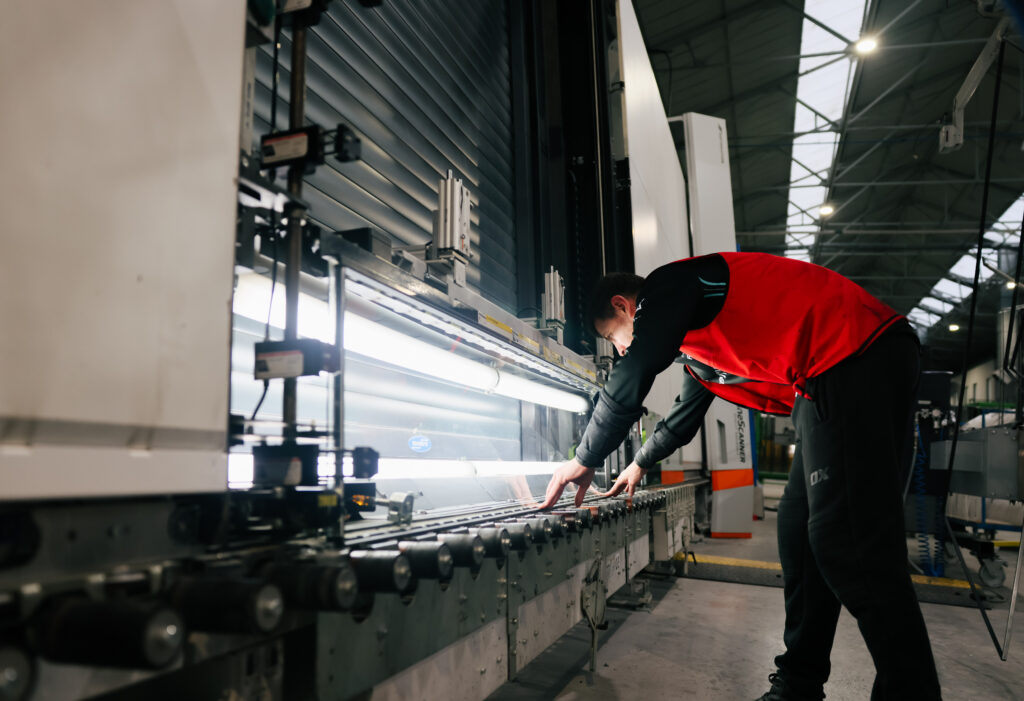
Tenon’s insulated glass lines cover a broad spectrum of production, from semi-automated systems through to fully automated lines incorporating integrated edge deletion, gas presses, spacer application, corner taping and sealing robots. For FGS managing director David ‘Oz’ Cahill, the appeal lies in their balance of capability and value.
“Tenon’s IG lines really hold their own against European alternatives,” he says. “In terms of performance, durability and output quality, they’re right up there with far more expensive systems. The difference is that UK manufacturers can achieve that level of capability with a much lower upfront investment.”
Local support
However, Oz is quick to stress that machinery alone is only part of the equation. FGS’s success has been built on Oz’s desire to bring global, cutting-edge engineering to UK factories without compromising on service. Which is why one of the most important developments in the FGS–Tenon relationship has been the establishment of a dedicated FGS office in China, run by Catherine Li.
“Catherine plays a crucial role,” Oz explains. “There are obvious differences in language, culture, time zones and even engineering approaches. Having someone who understands both sides – and who can translate not just words, but expectations and technical detail – makes a huge difference to how smoothly projects run.”
Catherine sees her role as ensuring continuity from initial specification through to installation and aftercare. “UK manufacturers quite rightly expect clear communication and fast responses,” she says. “My job is to make sure that feedback, questions and technical requirements are understood immediately by the factory, so that solutions are delivered without delay.”
This relationship also feeds into product development, Catherine explains. “Because we are close to both the manufacturer and the end user, we can spot where processes could be improved or automated further. That dialogue helps Tenon refine its equipment in line with UK and European expectations.”
One recent example of that refinement is Tenon’s introduction of robotic spacer bar application. Installed on its first line towards the end of last year, the system automates a process that has traditionally relied heavily on operator skill.
“Spacer application is critical to IGU quality,” says Catherine. “By using robotics, we eliminate variability and reduce the risk of human error. The result is more consistent units, improved efficiency and less rework.”
For Oz, this development is particularly significant: “Robotic spacer application brings Tenon right in line with premium European brands, but without the same price tag. For manufacturers looking to future-proof their production, it’s a very compelling option.”
Partnerships built to last
FGS’s emphasis on building long-term partnerships is reflected in its customer base. One example is Northern Express Glass (NEG), a domestic and commercial glass manufacturer that has worked with FGS for more than 20 years. In 2025, NEG opened a new facility in Lancashire to increase capacity by an additional 400–700 sealed units per day.
FGS supplied the core equipment for the site, with NEG managing director Paul Williams highlighting the importance of the relationship: “The machines are excellent, but just as important is the advice, technical support and aftercare. We know we can rely on FGS and that gives us confidence we can meet our customers’ needs for many years to come.”
For FGS, it’s that mix of proven technology and strong support that is central to its partnership-based approach. As Catherine puts it: “Quality isn’t just about how a machine is built. It’s about how it’s supported, how it’s used and how well everyone involved works together.”