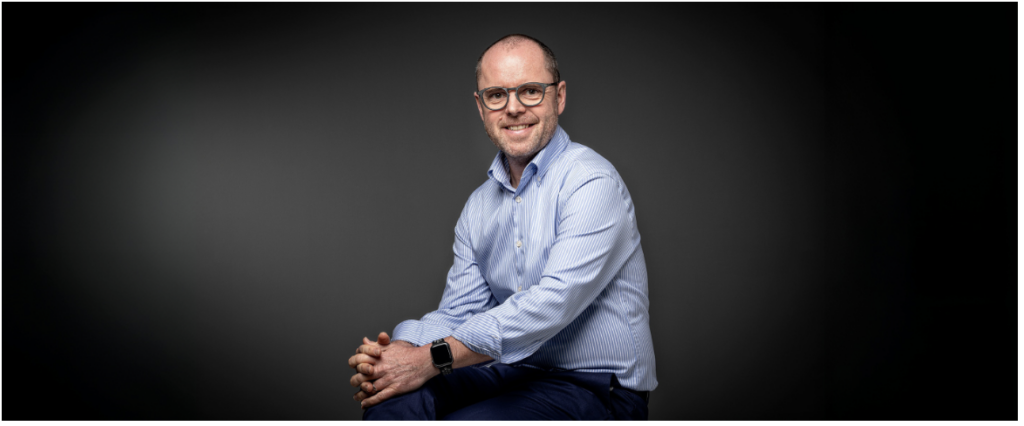

Mark Pearce has worked for KJM group for 40 years, working his way up from the fitting teams to sales and eventually leading the company as managing director. Here, we talk to Mark about his journey over the last four decades, what has made KJM such a successful business and his thoughts for the future
You started working for KJM not long after the company was founded in 1983 – describe your journey at the company over the last 40 years.
I joined KJM on a Young Workers scheme back in 1983, after leaving college and quitting A-levels, much to the disgust of my parents. My first job with KJM was outside labouring with both a builder and some fitters. I progressed to working with an installation team, but thought this was not for me, it was a cold first winter working outside.
Back in the day KJM manufactured windows, so I asked if I could move into the factory. I joined a team of three, manufacturing a Dutch profile called Wavin. They supplied tilt and turn profiles, that were pretty basic. The main delivery of profiles consisted of a sash and a t-shaped mullion. To make a L-shaped frame we ran the mullion through a bench saw to cut one of the legs off. They really were interesting days.
The management realised we needed a casement window, so we started manufacturing windows from Veka profiles, the casement system being the externally glazed ‘System E’. We had a single head ‘V’ welder and corner welder, that was being used all day every day. Frames and sashes were cleaned up with a ‘death to fingers machine’ called a hand router, moon-knife plus a mallet and chisel. Gaskets were pushed in with your fingers and thumbs. To this day the arthritis and scars on my hands prove my early history in our factory. KJM manufactured until 1996, finishing with technology that included a double-headed welder and a corner cleaner….gaskets were still being put in by hand though.
I became the production supervisor and then manager whilst in the factory, my tasks included using our BBC B micro that produced our cutting lists and glass sizes ready for manufacturing. The coding/programming for this was all produced by one of the original owners, we were at the very beginning of the high-tech era!
I went out canvassing in the evening for the company to earn extra money. The management realised I had a knack for sales, so offered me more evening work and gave me sales calls as well as canvassing.
I’ve always been a confident person, so with my fitting and manufacturing knowledge, selling was a doddle! At the time I think my salary in the factory had risen to the dizzying heights of £11k per year and I had been offered an additional 2.5% commission plus expenses for my out of hours sales calls.
I was totally driven by money and wanted to get myself a Cavalier 2.0 CDi so worked every hour available to me. Within a few months I was selling around £100k per month, so my commission payments meant I was on some serious money. My life was rosy, I lived at home, I even bought a house that I let to a friend to get on the property ladder in a time when interest rates were double digits.
By the mid 90’s I realised people wanted more than externally glazed windows and started asking questions to the management about selling other products, like aluminium or even internally glazed windows! It became apparent very quickly that our small-scale operation meant manufacturing was no longer financially viable so pushed for a full-time role in sales with a company Cavalier 2.0 CDi, that was given to me about a year before our factory closed.
So, from the mid 90’s my sole role was selling and in 2002 I was made a director of KJM. In 2006, I managed to buy a 50% shareholding in the company following a retirement of one of the owners and in 2009, I bought the whole company – not great timing with the 2008 banking crash.
I had no additional money, so wiped-out the company balance sheet and my father made me a very wise interest only loan that I had repaid in full and more by the time of his passing. I implemented many changes, however the core values of the company remained, including a salaried sales team and a total focus on customer service.
How has the industry changed since the ‘White Gold’ days of the 1980s?
White Gold was a TV show that put a huge smile on my face, and probably highlights every bad perception of this industry by the general public. I believe this has helped the rise of quality independent local companies – I always personally relish taking on the larger installers.
I’m passionate about being upfront and honest, offering the very best in customer service and market leading products. I’m not a fan of sales gimmicks like offering double digit discounts, interest free or buy now pay later credit deals. We advertise the fact that generally these deals costs someone something, so are not always what they seem.
You pushed hard to introduce aluminium and timber products, tell us a bit more about this decision to broaden KJM’s portfolio.
Choice is a KJM byword and I believe a massive part of our success. My first sales training buzz line I remember was ‘find out what the customer wants and give it to them’. I often thought in the early days aluminium or timber would not be my own choice, however if someone asks for it why try and talk them out of it?
Timber alternative PVC windows and foils have increased in popularity in the last few years, how much ‘premium’ product do you sell compared to ‘standard’ white windows?
If someone had told me 10 or 15 years ago, that we would be purchasing uPVC windows that were approaching or over £1,000 each that we then had to put a margin on, I would have smiled and thought they were mad – the same goes with timber windows!
My hat goes off the system houses that came up with the new multi-chambered flush casement systems, with either a mechanical joint or a Graf type join/weld. Our showroom has many different systems on display and the quality products sell themselves.
I often liken the window selling journey to buying a bottle of red in the restaurant. I’m not a wine snob, but if the cheapest bottle on the menu was ok, I’d probably go for the next one up…
It is the same with windows, there will always be the market for the white, grooved jointed welded window, however everyone sells that, so it’s about being different and offering choice.
Aside from offering the right products, what has been the key to KJM’s success over the years?
The key to almost all businesses is in my opinion is the 3 P’s – Products, People and Processes.
Products we’ve touched upon, and staff have to be on-board with your processes. My entire ethos is to do the best job you can with the customers you have. If you do, they will be a massive part of your future.
I really don’t like the typical double glazing sales person and in my years we have taken youngsters who have the ability to talk to people and taught them what we know. I always say if you don’t know the answer, then tell them. Honesty is always the best way.
Finally, we try and ensure the customer service journey starts from the day the prospective customers ring, email or call in. We don’t canvass or buy leads in, they all come to us organically.
From this point we treat them with total respect and rarely price in the home. All quotes are emailed or posted, with one follow-up telephone call to ensure they have received it and answer any questions they may have. If they are awaiting other quotations we ask if we can contact them again and depending upon the answer, it may well be the last time they ever hear from us. In my opinion, not hounding a potential customer is the best way to earn trust. You would be amazed by how many return, months or even a year later stating ‘you were the only company that did not harass us’.
You recently ran a customer survey – can you give us some insight into the results?
I asked our surveyor to take out a questionnaire that asks three simple questions. The answers are obviously only from customers that have placed an order from us and before they had the installation.
- Have you used KJM before?
- Did you get any other quotations, if yes how did we compare price-wise?
- Why did you decide to buy from KJM?
The results astounded me, firstly there have been very few people that have not completed the survey, so the results really are a true reflection of our selling process. In the first batch of responses (about 50 surveys) 67% of our customers who purchased from us did not get another quotation. If they did get a quotation, more often than not we were more expensive.
Responses for the reasons to purchase in order of importance included recommendation, reviews, website, age of business, range of products and friendly no-pressure sales teams.
Lately this number has decreased to around 50%, my guess is most people are starting to feel the cost of living pinch, so are just checking the market place.
Are homeowners more knowledgeable about windows and doors these days? Do they research online before approaching you?
The world has changed so much from the days of a sales-presenter, sample and the odd laminated letter from a customer saying what a great job we did. Today information is king. Let’s face it, you don’t need to go to a dodgy hotel or restaurant anymore with online review sites, and the same goes with this industry. There are many that research and then contact us. I think a lot of the time the decision is made – they can either afford it or they can’t – especially if they have received recommendations and can see great online reviews.
Bu our showroom is still an essential part of the sales process. Unless the KJM sales team are travelling far from base, we rarely carry samples as we believe that a decent showroom show-cases your whole business process, including things like awards and accreditations.
We could see stricter regulations on Part L in just two years’ time, with talk of a greater reliance on triple glazing – do you think the industry is ready for triple?
We have been selling it very successfully for over 12 years, so yes, we are ready! But are the manufacturers ready? We know there are aluminium profiles already struggling with current energy ratings, the industry was woefully slow with trickle vents and I’m still awaiting a quality and affordable overhead option in a drip.
My biggest worry will be the introduction of wider (front to back) frames, that will mean chopping back internal plaster-lines and window boards. Let’s hope we embrace it sooner rather than later and there are not supply issues that continue to push up costs.
What are your thoughts on trickle vents? Have you had any negative feedback from customers?
In three words ‘I hate them’! However, I see the need for them if you have no other forced ventilation into the home. Positive input ventilation is the way forward for the industry in my opinion, especially now people are pushing Pulse testing as an ‘alternative to the mandatory installation of trickle vents’.
However, while you can compare the air-leakage before and after the installation, what happens if it fails? Who is going to retro fit vents into newly installed windows?
What is your outlook for the year ahead – and what plans are in place for KJM for the future?
The year has started well for us. We have just invested in the third incarnation of our website since I’ve fully owned the business, and this should be online at the beginning of the 2nd quarter. Keeping abreast with SEO is very important especially as most people are viewing them with a mobile phone.
I’m 57 this year, so come September I will have been in the industry for 40 years. Am I looking for more growth? No, certainly not. I’ve done all I want to do with KJM. The world is a very uncertain place at the moment and we really have made some very poor political decisions over the last 10 years or so, that may well hamper the future UK economy.
So, consolidation in what could be very lean years in front of us is the key to not having sleepless nights and not having to make anyone redundant, something I’m proud to say we’ve never done. That said glass half full is always better than half empty, so KJM will always be chasing the higher end deals, not the people lured by supposedly cheap finance, so the future is rosy.