

The window and door industry faces a distinct set of challenges at the start of 2025, but according to Jody Vincent, sales director for Emplas, there are also major opportunities for growth.
“There is a difference between reality and perception,” argues Jody Vincent, sales director, Emplas.
“A lot of people ended last year feeling that things were fairly tough. Over the course of a year, the market was, however, broadly up – around 10-13% based on our analysis.
“That’s something that we need to keep in mind at the start of this year. There are some clear headwinds, the increase in national insurance and still low consumer confidence – but the long-term outlook is more positive – even if we’re going to need to hang tough at the start of the year.”
Jody argues that the somewhat pessimistic flavour to the start of 2025 can be attributed to an accelerated and prolonged seasonal drop in sales and leads at the end of last year, particularly in the period surrounding the Autumn Budget.
This relates to two significant governmental policy changes, which he suggests have negatively impacted business, namely the National Minimum Wage Increase and National Insurance (NIC) Increase.
Rising from £11.44 to £12.21 per hour for workers aged 21+ from April this year for a full-time staff member (37.5 hours/week), it introduces an annual wage increase of £1,502 per employee.
Industry will also have to absorb a second ‘hit’ with National Insurance increase which is also rising from 13.8% to 15%, while the threshold for employer NICs drops from £9,100 to £5,000 per annum.
As an illustration this means that a business employing workers at £25,000/year will see an additional annual cost of £804.60 per employee.
“It’s a significant impact for business,” Jody continues. “We have very few employees on National Minimum Wage, but in common with all businesses, the increase in National Insurance will inevitably increase our employment costs.
“We’ll continue to look for efficiencies from within our own operations. The investments we have made in the last year and those that we will continue to make in our operations this year, allow us to minimise the impact of those changes on our customers – but it is tough.
“For those fabricators who are heavily reliant on labour and have perhaps under-invested in their machinery, then I think it is going to be difficult.”
Emplas has tackled many of these challenges head-on by investing heavily in automation and manufacturing efficiencies. In March 2024, it opened a new 25,000ft2 dedicated door manufacturing facility at its Wellingborough hub.
This was aligned to the expansion of its composite door offer including the launch of the new 44mm timber cored BritDor Composite Door range from DoorCo, which now joins Emplas’ Original highly energy efficient foam cored DoorCo offer, and the top of the range, hybrid timber/foam core GripCore composite – giving installers the opportunity to sell at three distinct price points.
The creation of a dedicated composite door facility also allows for greater production capacity, efficiency improvements, and better cost control. In moving door production into a separate unit, it has given Emplas flexibility to redesign its main factory to eliminate inefficiencies, ensuring higher output while mitigating rising labour costs.
This was accompanied by further investment in advanced automation to cut manufacturing costs
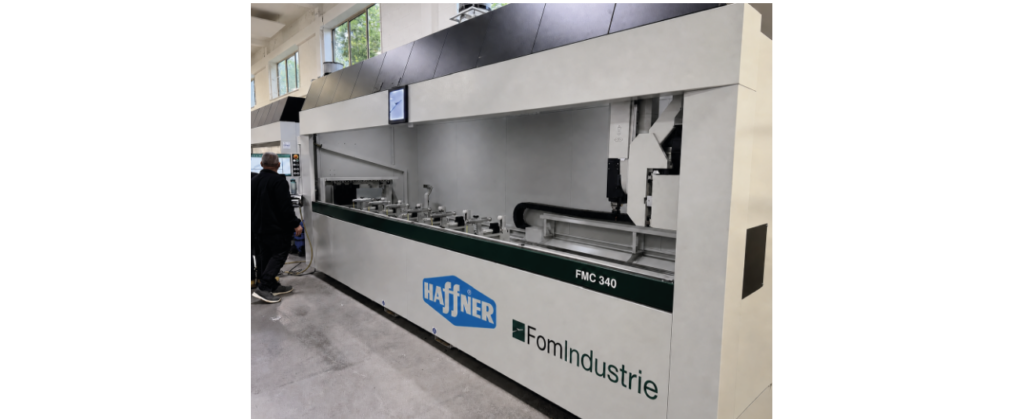
and increase quality. This includes the addition of two further Stuga ZX5 automated sawing and machining centres, which add 1,600 frames per week (fpw) in cutting and machining capacity.
“We’re investment-led, but the timing of the restructure of our manufacturing facility and its expansion has been very important in giving us an exceptionally solid foundation for this year,” said Jody.
“Given the wider economic context is important, as I’m not convinced all installers can be quite as confident in their supply chain.”
Jody, however, argues that despite challenges, 2025 presents opportunities for continued market expansion, especially with a projected 6.9% growth in new residential construction following a 7.1% contraction in 2024. The overall construction sector is forecast to grow by 2.9%, offering a more optimistic landscape.
And while consumer and business confidence may remain fragile, longer-term economic and housing market predictions for 2025 offer some ground for optimism.
The UK economy is set to grow between 1.2% (Goldman Sachs) and 1.6% (IMF) in 2025. Inflation has been brought down to 2.5% in December 2024, and is expected to average 2.6% in 2025 before stabilising.
“There’s an expectation that the Bank of England (BoE) will cut interest rates,” Jody continues, “with predictions that rates could drop from 4.75% to as low as 3.75% by the end of the year, making mortgages more affordable.
“That’s leading to a more positive outlook for the housing market which is projected to grow between 2.5% (Knight Frank) and 4% (Savills and Rightmove) this year, driven by lower mortgage rates and a limited housing supply.
“That’s another very positive area of medium to longer term opportunity – Government targets for housing.
“The Government has committed to targets for housing, aiming to deliver 1.5 million new homes by 2030 (300,000 per year). That will translate into increased activity in Q3 and Q4, and through into 2026.
“The picture may be mixed at present. The housing market recovery, government homebuilding targets, and falling interest rates will, in the longer-term, support industry growth.
“We’re investing for that future so that our customers continue to win business and grow.”